
Useful links
Contacts
With Alphard Erasmus+ is sustainable, tailor-made and concrete.

Zero
carbon mobility project
Towards a model of sustainable mobility applied to the Erasmus + program
2025 Copyright. | Created with Flazio.com
Emissions Zero
What is Alphard Zero Carbon
Alphard Zero Carbon is the program developed by Alphard in 2022 to ensure that every Erasmus+ mobility of ITS is carried out sustainably.
The project combines scientific calculation methods, concrete actions to reduce emissions, and certified offsets, offering Institutes clear and verifiable communication tools.
The pillars of the project
Measure & Compensate
Reduce before offsetting
Circular economy
Compliance & Transparency
We promote anti-waste guidelines: reusable kits, water refills, separate waste collection, local and responsible suppliers.
All procedures are documented and verified with ESG indicators. Each ITS has access to shared dashboards and receives final certification.
We calculate the carbon footprint of each trip and offset it through certified projects (VCS/Gold Standard). Each group receives a transparent report.
We promote low-emission choices: trains, direct flights, shared transfers, sustainable accommodations, and waste reduction plans.
Why join the Alphard Zero Carbon program

REPUTATIONAL VALUE
Institutional communication supported by a dedicated label (Erasmus Zero Net)
ALIGNMENT WITH THE SDGs
Each activity is consistent with the objectives of the 2030 Agenda, with measurable and reportable results.
TRAINING ENGAGEMENT
Students become ambassadors of sustainable practices during mobility.
COST OPTIMIZATION
Reduction of waste and logistics costs thanks to shared transfers and conscious choices.
SUSTAINABLE NETWORK
Privileged access to partners, incubators, and international companies sensitive to sustainability.
The Alphard Zero Carbon project directly contributes to the achievement of six
Sustainable Development Goals (SDGs)
- SDG 4 – Quality Education
- SDG 9 – Industry, Innovation and Infrastructure
- SDG 11 – Sustainable Cities and Communities
- SDG 12 – Responsible Consumption and Production
- SDG 13 – Climate Action
- SDG 17 – Partnerships for the Goals
Completed projects and certifications
📌 Project 2022 — Erasmus+ ITS
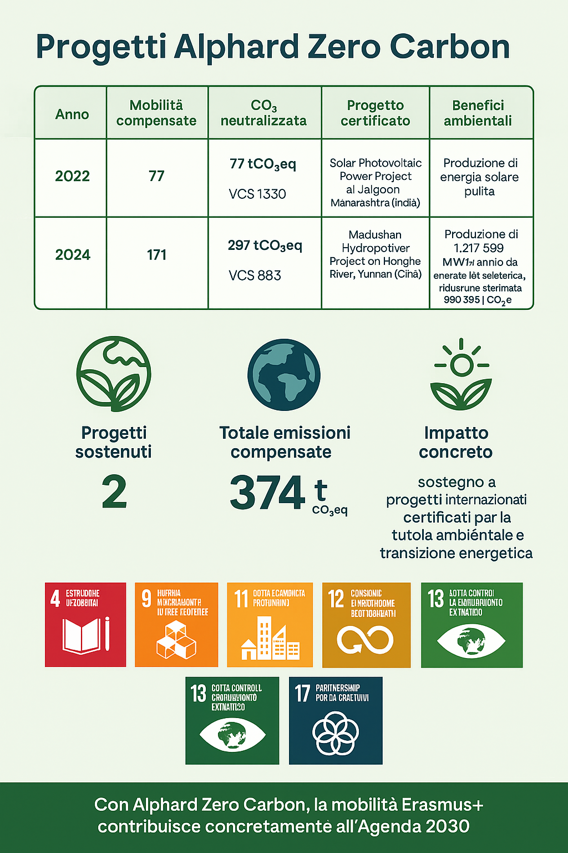
In September 2022, Alphard collaborated with Rete Clima, cancelling 77 certified carbon credits related to the VCS 1230 project – Solar Photovoltaic Power Project at Jalgaon, Maharashtra (India). This action made 77 student and staff mobility emissions zero, with credits officially registered and retired on the Verra Registry.
📌 Project 2024 — Erasmus+ ITS
In November 2024 Alphard neutralized the Carbon Footprint of 171 study trips, supporting the VCS 883 project – Madushan Hydropower Project on the Honghe River, Yunnan (China). The project generates 1,217,569 MWh/year of clean energy, with an estimated reduction of 906,656 tCO₂e/year.